Coalition for the Homeless
“Mobile Soup Kitchen”
The Founding of the Coalition
In the late 1970s, homelessness in New York City reached crisis levels. Thousands of people were sleeping on the streets, many suffering from untreated illnesses, injuries, or exposure to the elements. Amid this emergency, attorney Robert Hayes filed a groundbreaking class-action lawsuit in 1979 on behalf of homeless men across the city. The case, Callahan v. Carey, was built on the New York State Constitution’s requirement that “the aid, care and support of the needy are public concerns.” With Robert Callahan, a man living on the Bowery, as the lead plaintiff, the court ultimately ruled that the city must provide shelter and maintain certain standards for those facilities. Out of this landmark decision grew the Coalition for the Homeless, formed to oversee shelter conditions and hold the city accountable for its new legal responsibilities.
Although Callahan himself passed away before the decree was signed, the case had lasting consequences. The coalition became a watchdog, pressing the city to uphold its obligations whenever shelter conditions fell short. Through years of advocacy and legal action, it worked to ensure that the right to shelter was more than just words on paper, but a real guarantee of safety and dignity. The work remains urgent today: as of June 2025, more than 105,000 people were staying in shelters each night, with thousands more unsheltered on the streets and nearly 200,000 doubling up in other households. The scale of the crisis underscores why the coalition’s role – born out of a single lawsuit – continues to be vital.
The Mobile Soup Kitchen
The Coalition’s goal is to improve the lives of all underserved New Yorkers, not just those who are unhoused. In 1985, after a woman tragically starved to death in Grand Central Station, the organization launched the Grand Central Food Program (GCFP) the very next day. Colloquially known as the “mobile soup kitchen,” it grew into the largest program of its kind in the United States, serving between 800 and 1,200 people every night.
The GCFP meets people where they are — whether in shelters, on the streets, or housed but struggling with food insecurity. Volunteers travel across the city in vans, distributing meals, clothing, and other essentials directly to those in need. Supported by corporate sponsors, the program ensures that food insecurity, like homelessness, does not go unseen or unanswered in New York City.
Routes
The GCFP operates multiple distribution routes across Manhattan and the Bronx, including two routes in Manhattan. Each route is designed to reach different populations and neighborhoods:
-
Manhattan – Downtown: Serves street homeless populations and the city’s Asian community. This is the shortest route.
-
Manhattan – Uptown: Focuses on street homeless individuals, local churches, a large shelter, and people living in Central Park.
-
Bronx: Targets both shelters and individuals experiencing food-insecurity who are more likely to have some form of housing. This is the longest route.
Despite an ongoing commitment to never miss a day of distribution, GCFP has adjusted its routes over the years. Changes are sometimes prompted by low attendance at certain sites or safety concerns for both clients and volunteers.
What we Provide
The GCFP operates seven days a week, offering different items depending on the day. On weekdays, volunteers distribute cups of soup and bagels. On weekends, the program provides sandwiches, juice, milk, oranges, yogurt, and mustard. Occasionally, special items such as matzah crackers or granola bars are included, ostensibly donated from local organizations.
Experience
Arrival
Coalition for the Homeless’s mobile soup kitchen is based out of St. Bartholomew’s Church, where the organization keeps its vans and partners with the parish to operate the nightly project. Although volunteers are expected to arrive at the side entrance off Park Avenue by 6:45 in the afternoon, food distribution officially begins earlier, at 5:30, when Coalition staff stand next to the vans at the entrance and provide meal bags to anyone who approaches. Distribution at the church continues until 7:00, when the vans depart. On cold days, volunteers wait inside the building until everyone has gathered; otherwise, they remain outside near the vans. Since the vans leave promptly at 7:00, arriving on time is essential.
Vans
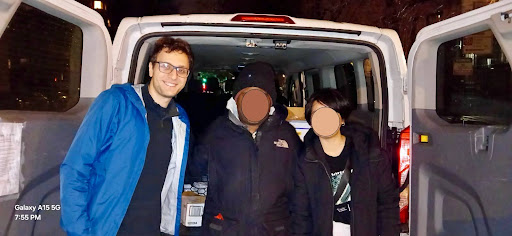
The mobile soup kitchen operates three vans, each identified by a numbered placard on the windshield that corresponds to a specific route. The same van always serves the same route. Each van has a large decal on the side identifying it as a Coalition for the Homeless vehicle, so that individuals on the street seeking food can easily recognize it. The vehicles are Ford Transit-350 Crews, equipped with a three-person bench seat in the back and a single sliding door on the right; the downtown van has an additional seat behind the bench. The vans are recent enough to support Bluetooth music pairing, which drivers sometimes use to make the rides more enjoyable. The sliding door can be finicky and requires a strong slam to close. The van’s rear cargo area is rather roomy, and has two doors that swing out at the rear for easy access.
Each van’s back is pre-stocked by Coalition staff before departure with crates and boxes containing:
-
Sandwiches: cheese or turkey bologna (a pork-free lunch meat), made at a Bronx facility and shipped in.
-
School-style milk cartons.
-
Fruit juice cups: fruit punch, grape, or apple—very sweet and popular.
-
Flavored yogurt cups with plastic spoons.
-
Oranges: any bad ones are discarded under the rule “don’t serve what you wouldn’t eat.”
-
Mustard packets: either Mike’s Amazing or Chef’s Quality; if it’s a day with Mike’s, the route is guaranteed to go well!
-
Standard plastic bags, usually kept on the bench seat.
On the Route
At 7:00 p.m., the New York Cares team leader assigns volunteers to one of the three vans. Each van can hold up to four people, excluding the driver, but usually three are assigned. Team leaders try to create a mix of newer and more experienced volunteers in every van, so that knowledge is shared and the project runs smoothly. Some first-timers worry that they might be asked to drive, but this never happens — drivers are selected in advance. When a driver is relatively new, a veteran volunteer usually rides in the front passenger seat to help with navigation.
Once everyone is loaded in, the vans head off from St. Bart’s toward the first stop. Depending on the route, that drive can take anywhere from five minutes to half an hour. During this time, volunteers are asked to “prep bags”.This means opening a prepackaged sheet of plastic bags (about 50 packed together) from one of the boxes on the van’s bench, separating and crumpling them, and then stuffing them all into one bag to create a single “bag of bags”. Ideally, each van has three or four ready before the first stop. These are essential, since every client receives one to carry their food. Preparing them early allows the bag distributor to easily hand them out.
When the van arrives, the driver parks in an accessible spot along the street. Often, a line of people has already formed in anticipation of the van’s arrival. Clients are expected to line up at the rear doors, where the volunteers set up. Two stand at the back distributing food — one handling sandwiches, spoons, and milk, the other covering juice, oranges, and yogurt. The driver usually distributes the empty bags from the “bag of bags” to each client, while another volunteer passes out mustard packets, checking whether or not each person wants one.
When a client reaches the front of the line, they open their bag and receive at least one of each item (unless the item has run out or they decline it). Depending on supply levels and the situation, they may receive more, which is detailed later. Once everyone in line has been served, volunteers wait an extra two or three minutes in case anyone arrives late. After this brief buffer, everyone piles back into the van and they move on to the next stop.
When there is downtime between stops, volunteers try to build a supply of pre-made bags. These contain the full set of items and are kept at the front of the van, between the driver and passenger seats. They serve two purposes: to hand out quickly if the van passes someone clearly in need, or to give to a client who arrives just after the line has ended, without having to unload supplies again.
After completing all stops, the van returns to St. Bart’s. Volunteers collect their belongings before leaving, since drivers are instructed to lock the keys inside the vans at the end of the night. With that, the project concludes.
Food Allocation
Deciding how much food to give each client is one of the trickiest parts of running a mobile soup kitchen route. Several variables change week to week:
- The amount of food stocked in the van can vary.
- The number of clients at each stop can fluctuate greatly, influenced by holidays, weather, season, or other factors.
- Some clients may directly request more food than the standard portion.
Despite these variables, food allocation is guided by several goals:
- All clients at all stops should receive at minimum one of each item
- No food should be left in the van by the conclusion of the route
- Ideally, extra food should be distributed equally between all stops
- It is unfair for, say, the first stop in the route to routinely receive double or triple portions if this means the later stops always tend to get a single portion
Approaches and Principles
Different volunteers bring different philosophies to food distribution. Some follow a strict minimum-portion approach, while others place greater weight on client requests.
Common principles include:
- A strong sense of obligation to comply when a client asks for extra food.
- If one client at a stop receives extra food, all clients at that stop should as well, to ensure fairness.
It is important to remember that poor allocation early in the route cannot always be corrected later. If a van has a large surplus by the final stop, many clients will reject excessive quantities of one item — few people want, say, ten cartons of milk at once.
Skills of a Food Allocator
The volunteer who takes charge of rationing plays a critical role in balancing fairness, practicality, and client dignity. They need:
- Strong knowledge of the route and its typical attendance.
- The ability to adapt to the day’s circumstances.
- A good eye for gauging how much food remains in the van at any given time
- The confidence to say “no” when appropriate.
- The trust and support of the rest of the team.
Saying No
Volunteers should do their best to accommodate clients’ requests whenever possible. Meeting these requests helps build trust and shows care. However, sometimes it is essential to say no in order to ensure fairness and to serve the full route. In those cases, volunteers are encouraged to remain respectful and matter-of-fact: explaining that food is running low and that everyone across the route needs to be served. Nearly every client understands and respects this reasoning when it is conveyed with kindness.
Final Stops
Certain routes' final stops shape how food distribution is handled.
On the uptown route, the last stop is in Central Park. Clients that request food here are presumed to be actively living in the park. This is an extremely challenging lifestyle, which means it is extremely important that all clients at this stop receive food.
When I’m in charge of uptown food rationing (which I usually am when I run this route) I require a minimum number of pre-made bags set aside for this last stop. We aim to give clients as many bags as they want (with at least one guaranteed for each person). If extras remain, I or any other willing volunteers will take them home and hand them out in our neighborhoods to people who are clearly in need.
On the Bronx route, there is a shared understanding with clients at the last stop that all remaining food will be distributed there. Clients line up and receive food as usual. After their first round, each person re-enters at the back of the line. If new arrivals come after everyone has been served once, they are immediately brought to the front. The process continues with second and third rounds until all the food is gone.
My Take
Mobile soup kitchen is an absolute blast. There is nothing like this project. I have done all routes, and I’ll list my thoughts on each stop below
Bronx
- SW Corner of Randall Ave & Bryant Ave — “Truck Stop”
Usually quiet, with only 1 or 2 clients if any. Next to auto repair shops; often Latin music plays from nearby cars, which makes this stop particularly fun.
- NW Corner of Lafayette & Manida St — “Shelter Stop”
Around the corner of a shelter, so clients tend to arrive in waves. Often, folks collect food then return to bring more friends. This stop can take a considerable amount of time.
- Lincoln Hospital (Morris Ave & 148th St) — “Liquor Store Stop”
I don’t think there is an actual liquor store here, it’s often memorable due to 1–2 very intoxicated clients.
- 164th St & Ogden Ave — “Spooky Stop”
This stop always feels a little off. The lighting isn’t great, and by the time we get here the sun has already set, which adds to the uneasy feeling. That said, I’ve never had any problems with distribution here. The stop is surrounded by stores, and every so often a bus will pull up right next to us. When people get off, some of them hop into our van’s line.
- 170th St & Jerome Ave — “Cyberpunk Stop”
This stop is straight out of a movie. It faces a subway overpass hanging over Jerome Avenue, with traffic lights and storefront fluorescents spilling color across the street.
- Fordham Rd & University Ave — “Pizza Stop”
Right next to a pizza place I’ve always wanted to try. Somehow I’ve never had the chance. One day!
- Fordham Rd & Webster Ave — “Final Stop”
Fairly unremarkable. Just a stop on a road, with the aforementioned infinity queue of clients claiming items until the van is empty.
Uptown
- SW Corner 51st St & Broadway — “Stardust Stop”
This stop is right after the Stardust diner. We usually get a decent sized group of regulars. Once I even got an unaware tourist asking for food on this stop. It was quite the experience.
- Port Authority (40th St btw Dyer & 8th) — “Hidden Entrance Stop”
Usually quiet (about 3–5 people), this stop is perfect for making pre-mades. It sits on the far side of Port Authority, away from the stores, so the folks here either live nearby or come specifically for us. Once, I saw a group of folks exit a door embedded in the wall of one of the buildings here and come into our line. Since then, the door has been sealed over, but I will never forget my astonishment learning at that moment that the building was actively being inhabited.
- 79th St Boat Basin (79th St & West Side Hwy) — “Quiet Stop”
This stop is rather consistent – two clients and that’s it. We make a quick stop and move on.
- 86th St & West End Ave — “Church Stop”
Our first church of the route. Several iconic regulars here really define the uptown run for me.
- 112th St & Amsterdam Ave — “St John’s Stop”
And this is the second. We park next to the steps of the cathedral and hand out whatever we can to the small group waiting here. There are usually a handful of clients on bicycles.
- Harlem Hospital (137th St & Lenox Ave) — “Harlem Hospital Stop”
Harlem Hospital is usually a medium-sized group, which can, on certain days, be quite busy.
- Lexington Ave & 124th St — “Shelter Stop”
Always our largest stop. People stream out of the shelter in waves, making it tricky to gauge how much food to give out at once.
- Central Park (5th Ave & 72nd St) — “Central Park Stop”
We pull into a street that cuts into the park, where turnout is unpredictable — sometimes none, sometimes many. However many come, it’s essential we have enough food for all our clients here.
Downtown
- 35th St under FDR Dr — “Under-the-bridge Stop”
This stop is on the west side of Manhattan, under FDR Drive. The surroundings are a bit rough, but the East River views are beautiful.
- Chinatown (Lafayette & Leonard St) — “Chinatown Stop”
Right in the heart of Chinatown, this stop is usually packed. Clients here tend to heavily prefer milk.
- Staten Island Ferry — “Ferry Stop”
This ferry stop is so cool, primarily because it is in a location that one might visit just doing typical Manhattan touristy exploration.
- Sunshine Hotel / Bowery Mission (btw Stanton & Rivington) — “Chinatown 2 Stop”
I don’t think this stop is technically in Chinatown, but we see a large Asian population here as well.
- Madison Square Park (5th Ave & 27th St) — “Chipotle Stop”
Quiet stop next to a Chipotle. Nice place to wrap up the night.
The Ups and Downs
I would describe the mobile soup kitchen as both grungy and gritty – and that’s precisely why I love it so much. I don’t know of another project that feels more “New York” to me. There is a great need for the services that mobile soup kitchen provides, and it is particularly honoring to be able to contribute to them. It’s quite inspiring that an operation like this even operates in NYC.
I also really value the chance to see New York City from a vehicle. As a New Yorker, I walk everywhere, so being in a car feels unusual — almost like seeing the city through a new lens. The streets look entirely different from behind a windshield, especially in the rain, and it’s striking to move through so many neighborhoods in one night.
The clients truly are all different. You can’t assume who they are, what brought them here, or what kind of day they’re having. Each shift can swing wildly — one moment you’re facing a difficult situation, the next you’re catching a burst of unexpected joy.
The Ugly
Once, on the downtown route at the “Chinatown 2” stop, we ran into a troubled older woman we’d had problems with before. She treated our volunteers so poorly that we refused to give her extra items. That set her off into a full-blown meltdown right there on the street — screaming, grabbing onto the van’s door, and physically trying to stop us from leaving. It was explosive. Eventually, she let go and we pulled away, but it still stands as the worst behavior I’ve ever seen from a client.
The Beauty
The first few times I volunteered for mobile soup kitchen, I distinctly remember a gentleman on the downtown route (I think it was at the ferry stop) verbally reject additional food, giving a reason along the lines of “I don’t want to be greedy” and following it up with profuse gratitude. Something about that man’s sincerity has always stuck with me. The food we serve is extremely humble. To be so selfless to want to give, despite their hunger and trusting that the extra sandwich would go to someone else in need, was profoundly touching. That moment deeply shaped my outlook on public service as a whole.
Overall
It is such a beautiful feeling to meet someone in the five seconds it takes to fill their bag with food, providing perhaps the only meal they’ll have in the latter half of the day, ask them how they are, and send them away with a smile. Some clients are clearly struggling, and it shows in their interactions. Others carry gratitude in the forefront, appreciative despite the modest provisions. It is so stupid to be grateful for the incredibly basic provisions we provide. But yet, I think this gratitude is one of the most beautiful things I’ve ever seen in my life. In this life, I truly believe dumb things make the entire world so much more approachable and wonderous.
This project is as New York as it gets. I don’t know of another project that lets you meet so many everyday New Yorkers, right where they are. I might not know every street and avenue by name, how to pronounce “Hoyt–Schermerhorn”, or have seen a Mets game at Penn Station. But through the relationships I’ve built with clients that is project — who are one hundred percent as New York as it gets, I feel so unbelievably strongly that I am also one hundred percent a New Yorker too. And I am so appreciative of our clients for this.
I give this project top marks — extra mega super recommend. If you do one project in Manhattan, it should be this one. I tell everyone I meet: everyone should do this project at least once.
Sources
Content is heavily sourced from the Coalition for the Homeless’ website